Losing a client rarely comes down to price. It comes down to timing. A motor policy quietly lapses while you are buried in a claim. A health renewal falls due the same week three other deadlines hit. The window closes, another agent calls first, and an account you worked hard to win walks away.
Insurance policy management software exists to close that gap. Instead of juggling spreadsheets, WhatsApp threads, sticky notes, and a generic address book, it puts every policy, renewal date, document, and client conversation in one place — and reminds you before a renewal slips.
This guide explains what insurance policy management software actually does, the features worth paying for, and how agents, brokers, and small agencies can choose the right fit.
What is insurance policy management software?
Insurance policy management software is a digital tool that helps you manage the full life of an insurance policy — from the first quote through issuance, endorsements, renewals, and cancellation — in a single system.
It stores policyholder details, tracks premiums and expiry dates, automates renewal reminders, keeps documents together, and gives you a clear view of every client’s coverage.
Large carriers run heavy enterprise platforms for this, often called a policy administration system (PAS). But most of the people selling and servicing policies day to day — independent agents, brokers, and small agencies — do not need a carrier-grade PAS.
They need something lighter that tracks policies and clients, chases renewals automatically, and does not require a technical team to run. That lighter category is what this guide focuses on.
Why insurance businesses need it
If you sell more than a handful of policies, manual tracking eventually costs you money. The usual pain points include:
- Missed renewals and lapses. Renewal dates live in someone’s head or a spreadsheet, and one busy week is all it takes to miss a window.
- Scattered client information. Policy details sit in email, coverage notes sit in a notebook, and payment history sits somewhere else entirely.
- Repetitive manual work. Sending the same reminder, welcome note, or birthday message by hand eats hours you could spend selling.
- Weak retention. Clients who do not hear from you between renewals feel like a policy number, not a relationship — and they shop around.
- Compliance gaps. When records are informal, audits and disputes become stressful and slow.
Insurance policy management software helps address these problems by making renewals systematic, keeping records complete, and automating routine client communication that helps maintain relationships.
Core features to look for
Not every tool labelled “policy management” does the same job. These are the features that matter most for agents and agencies.
1. Centralized policy records
Every policy should be stored with the details you actually use: policyholder, policy number, carrier or insurer, coverage type, sum insured, premium, effective and expiry dates, and commission.
With everything in one record, you can search and access policy information in seconds instead of checking multiple spreadsheets or conversations.
2. Automated renewal reminders
The single highest-value feature is automated renewal reminders. The system tracks expiry dates and triggers reminders to you and to the client before a policy runs out.
A typical reminder schedule can be 30, 15, and 7 days before expiry. Automated reminders help create a predictable renewal pipeline instead of relying on manual follow-ups.
3. Multi-company and multi-line policy tracking
Most agents place business across several insurers and product lines. Good software lets you keep policies from different companies organised under one client.
This gives you a clear view of a household’s or business’s entire coverage and can help you identify cross-sell opportunities.
4. Client 360 view and lead management
A complete client profile should bring together every policy, past conversation, task, and follow-up in one timeline.
The system should also provide a pipeline to capture and track new leads from web forms, referrals, and calls so that potential clients do not go cold.
5. Document management
Policy copies, ID proofs, claim forms, and correspondence should be attached to the right record and easy to retrieve.
This reduces the need to search through emails or separate folders when handling a claim, client request, or audit.
6. Commission tracking
Record commission rates and splits against each policy so you know what you have earned and what is pending, without maintaining a separate spreadsheet.
7. Multi-channel communication
Reaching clients where they are — email, SMS, and WhatsApp — matters, especially in markets where WhatsApp is the default communication channel.
Look for the ability to send renewal notices, payment reminders, and campaigns such as birthday wishes across channels from inside the system.
8. Reporting and dashboards
Dashboards should provide visibility into renewals due, retention rate, premium under management, and producer performance, so you can spot problems before they cost you.
9. Compliance and audit trails
A dated history of changes on each policy record supports regulatory requirements and can help protect you if a client dispute arises.
Key takeaway: The best insurance policy management software is not simply the one with the longest feature list. It should help agents and agencies keep policy records organised, automate renewals, manage client relationships, and reduce repetitive manual work.
Policy management software vs. policy administration system vs. insurance CRM
The terms get used loosely, so here is the plain-English difference:
- Policy administration system (PAS): The carrier-grade engine that insurers use to build products, underwrite, rate, and issue policies at scale. It is powerful, expensive, and far more than an agent needs.
- Insurance policy management software (for agents/agencies): A lighter tool focused on tracking the policies you have sold — records, renewals, documents, and commissions — rather than manufacturing insurance products.
- Insurance CRM: Centres on the client relationship — leads, communication, follow-ups, and retention. In practice, the best tools for agents blend policy management and CRM, because a policy is only useful in the context of the client who holds it.
For most agents and small agencies, a combined insurance CRM with policy management built in is the practical sweet spot: it tracks the policy and the relationship in one place.
Who needs insurance policy management software?
Insurance policy management software can be particularly useful for:
- Independent agents managing a growing book across multiple insurers.
- Insurance brokers who need a clear view of client portfolios and renewal calendars.
- Small and mid-sized agencies that want their whole team working from the same records instead of personal spreadsheets.
- Agencies handling multi-line or multi-company business, where organising coverage per client is otherwise a headache.
If renewals, client follow-ups, and policy records are currently held together by memory and spreadsheets, this type of software can help reduce missed renewals and improve client retention.
For most small insurance businesses: You do not necessarily need a complex enterprise policy administration system. A combined insurance CRM and policy management solution can provide the practical tools needed to manage clients, policies, renewals, and follow-ups.
How to choose the right one
Before choosing insurance policy management software, evaluate it against the way you actually run your agency. Use this checklist:
- Does it automate renewal reminders the way you actually work, across the channels your clients use?
- Can it handle multiple insurers and product lines under a single client?
- Is it easy to set up without a developer or long onboarding process?
- Does it fit your budget — including a genuinely usable free plan or affordable entry tier, not just a trial?
- Does it combine policy tracking with client and lead management, or will you still need a second tool?
- Does it support your market — for example, WhatsApp messaging and local invoicing/tax needs if you operate in India?
- Can your whole team use it with proper access control?
Weigh these points against your agency’s workflow rather than choosing based only on the number of features. The most feature-rich platform is not useful if it is too complex for your team to adopt consistently.
The benefits, in short
- Fewer lapses and stronger retention, because renewals are systematic, not accidental.
- Time back, as routine reminders and messages run on their own.
- Better client experience, with timely, personal, multi-channel communication.
- Cleaner compliance, thanks to complete records and audit trails.
- Clearer decisions, from dashboards that show what is actually happening in your book.
How WebTrix24 helps agents and agencies
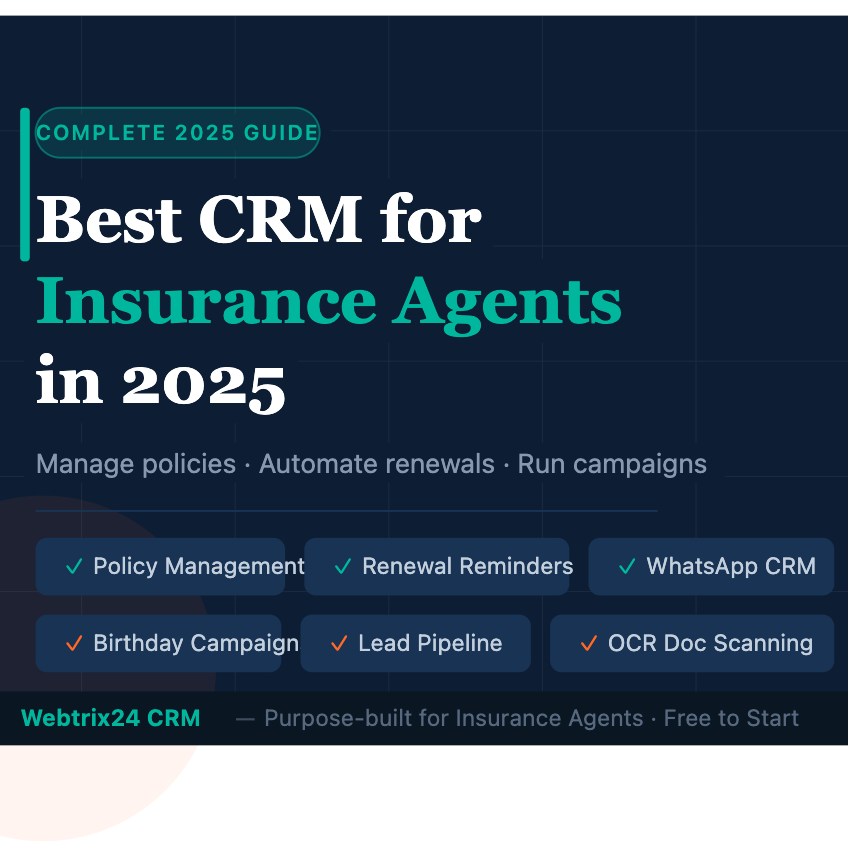
WebTrix24 is a free CRM built for small businesses, with an insurance module made for agents and agencies. It lets you handle customer policies and leads in one place, send automatic renewal reminders, and keep multi-company policies organised per client — so a household’s or business’s full coverage sits in a single view.
You can run campaigns like birthday wishes and renewal nudges over WhatsApp, email, and SMS, and manage the whole book without hiring a technical team.
For agents in India especially, the combination of WhatsApp communication, renewal automation, and an affordable free-to-start plan makes it a practical way to move off spreadsheets.
If you want to see how it maps to your workflow, explore the Insurance Agent CRM solution and the pricing plans to find the tier that fits your agency.
Frequently Asked Questions
What is insurance policy management software?
It is a tool that stores policy and policyholder details, tracks premiums and expiry dates, automates renewal reminders, and keeps documents and client conversations in one place, so agents and agencies can manage every policy through its full life cycle without spreadsheets.
Is insurance policy management software different from an insurance CRM?
They overlap. Policy management focuses on the policies you have sold — records, renewals, documents, and commissions — while a CRM focuses on the client relationship, leads, and communication. The most practical tools for agents combine both.
Can it help reduce missed policy renewals?
Yes. Automated renewal reminders track expiry dates and notify you and your clients well before a policy lapses, usually on a schedule such as 30, 15, and 7 days ahead, which directly improves retention.
Do small insurance agencies really need it?
If you manage more than a handful of policies across multiple insurers, manual tracking eventually causes missed renewals and lost clients. Even a free or low-cost tool typically pays for itself in retained business.
Is there free insurance policy management software?
Yes. Some CRMs, including WebTrix24, offer a free plan that covers policy tracking, renewal reminders, and client management, which is often enough for individual agents and small agencies to start with.
Ready to Manage Your Insurance Policies More Efficiently?
Stop relying on spreadsheets, scattered WhatsApp conversations, and manual renewal tracking. Bring your clients, policies, renewals, and follow-ups together in one organised system.
Start managing your insurance business with WebTrix24 Insurance CRM.